Home›Machines›De-Awner
De-Awner
MACHINERY CATALOGUE

De-Awner

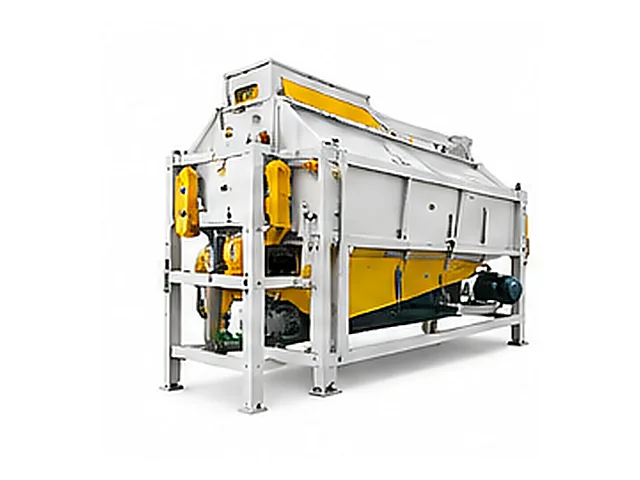
The De-Awner snaps brittle awns, rough beards, and clinging glume tips off barley, wheat, oats, and grass seeds so the conditioned grain flows freely through downstream spouts, silos, and precision grading screens. By subjecting the grain bed to controlled mechanical tumbling between rotating beater pins and stationary stator bars, the unit detaches unwanted appendages while preserving kernel germination and pericarp integrity.

Machines ↗

Overview

Inside the cylindrical barrel of the De-Awner, a central shaft fitted with hardened steel beater fingers rotates past internal counter-pins and ribbed casing plates, creating inter-granular rubbing and gentle impact that breaks off protruding beards. An adjustable weighted tail-gate at the outlet regulates how long the grain bed remains inside the chamber, allowing operators to dial in treatment intensity according to crop maturity and awn toughness.

Technical Specifications

Technical ParameterDEA-05DEA-10DEA-15DEA-25
Processing Capacity3 – 6 t/h7 – 12 t/h13 – 18 t/h19 – 25 t/h
Hulling / De-Awning / Conditioning Uniformity98.0% – 99.0% homogeneous processing98.5% – 99.2% homogeneous processing99.0% – 99.5% homogeneous processing99.2% – 99.5% homogeneous processing
Total Motor Power2.2 kW4.0 kW7.5 kW11.0 kW
Rotor / Drum Working Diameter400 mm500 mm600 mm750 mm
Aspiration / Husk Extraction Airflow2,500 m³/h4,200 m³/h6,000 m³/h8,500 m³/h

The capacity and power ranges indicated in the table may vary depending on the crop type to be processed, initial foreign matter rate, moisture level, and machine configuration. Exact performance and actual measurement values are finalized following the engineering design and process detailing of the plant to be installed.

Selection and integration

Selecting the right De-Awner configuration depends on crop species, harvest moisture, awn brittleness, and whether the grain is destined for certified seed drilling, malting, or commercial milling. Because overly aggressive beating can skin malting barley or crack dry embryos, pilot sample evaluation is used to establish rotor RPM, counter-comb spacing, and outlet gate pressure prior to commissioning.

Key points to specify

  • Confirm the crop, variety and incoming condition for De-Awner.
  • Document the intended result for the “De-Awner” unit against actual feed and line conditions; review: defined operation, adjacent equipment, incoming condition and outlet target.
  • For the “De-Awner” unit, check the operating choices against these factors: defined operation, adjacent equipment, incoming condition and outlet target.
  • Show the infeed, discharge, transfer points and service clearances for the “De-Awner” unit on the plant layout; evaluate defined operation, adjacent equipment, incoming condition and outlet target alongside the actual feed condition.

GUIDE · TECHNICAL SELECTION

What is this machine used for?

A De-Awner removes troublesome awns, spikelet tails, and clustering hairs from harvested cereals and seeds that would otherwise cause bridging in storage bins and blind screen perforations during fine cleaning. Positioned early in the cleaning tower, it increases bulk test weight and prepares a uniform, free-flowing feed for subsequent aspiration, screening, and indented cylinder separation.

01

The role in the process

When rough barley, bearded wheat, or chaffy forage seed enters a processing plant, interlocking awns often cause matting in bucket elevators and uneven distribution across cleaner sieves. Installing the De-Awner immediately ahead of the primary air-screen cleaner breaks up these clusters and detaches the beards so the aspirator and screens can remove them cleanly.

Detaching awns releases significant quantities of sharp silica bristles and light chaff that must be evacuated either through an integrated aspiration hood or in the air leg of the following cleaner. Project documentation clearly separates the mechanical drive requirements of the De-Awner from the dust-extraction airflow needed to keep the work area clean.

02

Material and application suitability

The De-Awner is widely applied to malting and feed barley, bearded durum and bread wheat, clipped oats, triticale, and specialty grass or vegetable seeds that carry hooked hairs or twin-seed stems. Incoming material should first pass through a scalper or magnet to remove coarse straw, stones, and tramp metal that could bend the rotating pins.

Awn removal efficiency is closely tied to grain moisture content: damp, Tough awns tend to bend rather than snap, whereas bone-dry kernels require lower rotor speeds to prevent hull peeling or germ bruising. Adjustable discharge weir weights and optional inverter speed control let operators adapt the machine as harvest conditions shift throughout the season.

03

Selection checklist

Engineering procurement checklists for a De-Awner should verify rotor beater style, drum liner thickness, variable speed capability, and dust extraction static pressure requirements. Commissioning sign-off criteria typically pair a target reduction in bearded kernels and an increase in hectoliter weight with a strict ceiling on skinned or cracked grains.

Confirm screen perforation geometry, scalping deck area, and aspiration air volume against peak harvest intake capacity. Pilot tests on high-trash field lots help calibrate stroke frequency and airflow dampers prior to commissioning. Adjusting screen inclination and air damper settings accommodates moisture swings between early and late harvest deliveries.

Integration into a processing line

Plant layout and interface planning

In standard grain cleaning towers, the De-Awner is mounted above or immediately after the receiving pre-cleaner and fitted with a bypass three-way valve so non-bearded crops can route around the drum without unnecessary handling. Layout drawings must leave sufficient headroom and side aisle clearance to swing open the heavy drum cover during service.

During initial startup on bearded crops, technicians record rotor frequency, tail-gate counterweight position, and ammeter draw alongside laboratory germination and skinning counts. Keeping these verified settings on file allows shift personnel to reproduce gentle de-awning whenever switching between malting and seed lots.

Factors that affect operating performance

Because the De-Awner relies on grain-to-grain rubbing as well as pin contact, running the barrel partially empty reduces de-awning effectiveness and increases direct steel-on-kernel impact. Maintaining a steady, choke-fed inlet stream and setting the discharge weir to keep the cylinder properly filled ensures gentle, uniform beard detachment across the entire throughput range.

Process quality and line integration

For certified seed plants that handle multiple cereal varieties daily, self-cleaning discharge slides and accessible internal stator bars prevent varietal admixtures during lot changeovers. Routine inspection of beater finger tips ensures that worn edges are rotated or replaced before de-awning performance declines.

Frequently asked questions

What specific plant appendages does the De-Awner detach from harvested grain?

The machine snaps off barley awns, wheat beards, residual glume tips, oat tails, and basal bristles, while also breaking apart double-seed clusters in grasses and umbelliferous crops. Removing these projections prevents bridging in bins and significantly improves test weight and seed drill flowability.

How is de-awning intensity regulated to protect malting barley and seed germination?

Operators adjust both the counterweight on the discharge retarding gate—which alters retention time and bed pressure inside the drum—and the rotational speed of the beater shaft when equipped with a frequency inverter. This balance snaps brittle awns cleanly without peeling the protective lemma or bruising the embryo.

Why should a bypass chute be installed above the De-Awner in a multi-crop cleaning line?

Many cleaning plants process both bearded cereals and smooth, clean-threshed grains or pulses within the same facility. Integrating a two-way diverter valve at the inlet lets smooth crops bypass the beater drum altogether, saving electrical energy and avoiding unnecessary wear on the internal pins.

REQUEST A TECHNICAL REVIEW

De-Awner

Planning to integrate a De-Awner into your cereal, malting barley, or seed conditioning facility? Share your grain species, incoming bulk density, moisture profile, and hourly line capacity with our application engineers to receive a tailored equipment proposal complete with rotor specifications, layout drawings, and aspiration requirements.