Home›Machines›Peanut Sheller
Peanut Sheller
MACHINERY CATALOGUE

Peanut Sheller

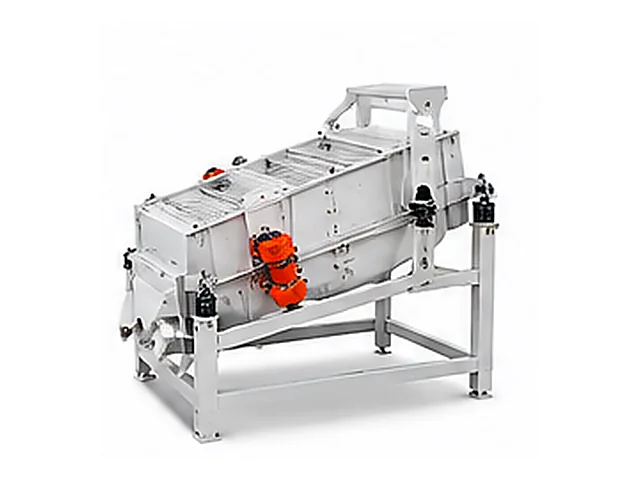
The Peanut Sheller cracks fibrous groundnut pods between ribbed shelling cylinders and interchangeable slotted concave grates to liberate whole redskin kernels with minimal splits or skin abrasion. Equipped with integrated lower aspiration and oscillatory separating decks, the machine blows away lightweight hull fragments while isolating clean kernels and routing unshelled small pods to a secondary shelling stage.

Machines ↗

Overview

Pre-cleaned peanut pods fed into the upper chamber of the Peanut Sheller roll between a rotating cast-iron or rubber-lagged drum and a curved grid of precision-spaced steel concave bars. As the pod shell fractures under controlled compression, freed kernels and cracked hulls drop through the bar slots into a rising airstream that extracts the shells to a cyclone while heavy kernels discharge onto a grading screen.

Technical Specifications

Technical ParameterPNS-05PNS-10PNS-15PNS-25
Processing Capacity3 – 6 t/h7 – 12 t/h13 – 18 t/h19 – 25 t/h
Hulling / De-Awning / Conditioning Uniformity98.0% – 99.0% homogeneous processing98.5% – 99.2% homogeneous processing99.0% – 99.5% homogeneous processing99.2% – 99.5% homogeneous processing
Total Motor Power2.2 kW4.0 kW7.5 kW11.0 kW
Rotor / Drum Working Diameter400 mm500 mm600 mm750 mm
Aspiration / Husk Extraction Airflow2,500 m³/h4,200 m³/h6,000 m³/h8,500 m³/h

The capacity and power ranges indicated in the table may vary depending on the crop type to be processed, initial foreign matter rate, moisture level, and machine configuration. Exact performance and actual measurement values are finalized following the engineering design and process detailing of the plant to be installed.

Selection and integration

Selecting and configuring a Peanut Sheller revolves around pod variety—such as large-pod Virginia, medium Runner, or small Valencia and Spanish types—along with pod moisture and target whole-kernel turnout. Matching the concave grid bar aperture and drum clearance to pre-graded pod sizes prevents crushing large kernels while avoiding excessive pass-through of unshelled single-seeded pods.

Key points to specify

  • Confirm the crop, variety and incoming condition for Peanut Sheller.
  • Define the target output and the acceptance criteria for the peanut shelling stage.
  • When setting up the “Peanut Sheller” unit, record hull structure, moisture, crop variety and acceptable kernel damage and assess both accepted output and unwanted product loss during the sample trial.
  • The line drawing for the “Peanut Sheller” unit should identify product transfer, service space and interfaces with upstream and downstream equipment; align hull structure, moisture, crop variety and acceptable kernel damage with the agreed output criterion.

GUIDE · TECHNICAL SELECTION

What is this machine used for?

A Peanut Sheller decorticates dried groundnut pods through calibrated drum-and-concave compression paired with immediate pneumatic shell separation. When preceded by thorough stone, stick, and soil removal and pod size grading, it delivers high whole-kernel recovery for edible trade, seed production, or oil crushing.

01

The role in the process

Because harvested groundnuts are lifted from the soil, raw pods often carry pebbles, earth clods, and fibrous vine stems that can gouge shelling concaves and scar soft peanut kernels. In a well-engineered plant, the Peanut Sheller is always preceded by a scalper, destoner, and pod sizer, and followed by a specific-gravity separator that separates any remaining unshelled pods from shelled kernels.

Multi-drum Peanut Sheller arrangements divide the workload into primary and secondary shelling cylinders fitted with progressively narrower concave grids so small pods escaping the first drum are cracked cleanly in the second stage. Proposal documents itemize drum motors, shaker drives, and hull aspiration blowers separately for accurate plant utility sizing.

02

Material and application suitability

Groundnut shelling performance is highly sensitive to pod size distribution and shell wall thickness across Virginia, Runner, and Spanish cultivars. Keeping a dedicated set of concave grates with bar spacings matched to each graded pod fraction is the single most effective way to hold split percentages and bald-head skinning to a minimum.

Pod moisture content must sit within an optimal curing window before shelling: overly dry kernels split along their cotyledon seam and shed their protective redskin testa, whereas damp, spongy pods resist cracking and blind the concave slots. Trial runs on cured customer pods establish the exact drum clearance and aspiration damper position. All contact zones support fast inspection. Air and feed controls lock repeatably.

03

Selection checklist

Before finalizing a Peanut Sheller specification, verify the number of shelling drums, included concave grid apertures, hull fan static pressure, and return-loop handling for unshelled pods. Commissioning acceptance criteria should stipulate minimum shelling efficiency, maximum split-kernel percentage, and maximum loose kernels lost in the aspirated hull stream.

Calibrate rotor peripheral speed, working gap clearance, and screen or concave perforation to balance hulling efficiency against breakage. Sample test runs at target grain moisture establish the optimal feed rate and husk separation settings. Controlled aspiration immediately strips detached hulls and fines to prevent over-processing and heat buildup. Cleanout doors simplify variety changeovers.

Integration into a processing line

Plant layout and interface planning

Layout planning for a Peanut Sheller must account for the bulky, low-density hull stream blown out of the aspiration hood, routing the pneumatic duct with wide-radius bends to an exterior cyclone or hull baling press. Kernel discharge chutes should use low-drop, cushioned transitions to prevent splitting naked peanuts during transfer.

During seasonal startup, operators log the concave grid millimeter spacing, drum-to-grid gap, and air-leg damper setting alongside laboratory counts of whole redskin kernels, splits, and bald heads. Adequate floor clearance beside each shelling cylinder makes swapping heavy concave baskets safe and fast.

Factors that affect operating performance

Maintaining a steady, full pod layer across the shelling cylinder allows pods to cushion one another and crack by shell-on-shell compression rather than harsh direct impact against the cast ribs. Erratic feeding or running the drum nearly empty increases kernel bruising and skin detachment.

Process quality and line integration

Balancing the lower aspiration airstream is critical: sufficient air velocity must lift all fractured shells cleanly off the oscillating screen, yet remain gentle enough that small whole Spanish kernels or half-splits are not carried over into the hull cyclone.

Frequently asked questions

How are splits and 'bald-head' skinned kernels minimized in a Peanut Sheller?

Whole redskin recovery is maximized by curing pods to the proper moisture level, pre-grading pods by caliber, and installing a concave grate whose bar spacing lets liberated kernels drop out of the shelling zone immediately upon shell fracture. Moderating drum rotational speed also prevents stripping the delicate red testa.

Why do industrial groundnut plants use multi-stage shelling drums with different grid spacings?

Natural pod lots contain both large two-kernel pods and smaller single-kernel nubbins. A primary drum with wider grid slots cracks the main pod fraction gently without crushing large kernels, while smaller uncracked pods pass to a secondary drum fitted with narrower concave bars.

What cleaning and separation equipment should precede and follow the Peanut Sheller?

Upstream pre-cleaners, destoners, and magnetic traps must remove field stones, soil clods, and metal before pods enter the drum. Downstream, oscillating screens, gravity separators, and optical sorters separate pure graded kernels from any remaining unshelled pods.

REQUEST A TECHNICAL REVIEW

Peanut Sheller

Planning a new groundnut shelling plant or upgrading existing capacity with a gentle Peanut Sheller? Share your peanut varieties, pod moisture range, desired hourly throughput, and edible or seed quality targets with our engineering team for a customized concave and line layout proposal.