Home›Machines›Spelt Huller & Separator
Spelt Huller & Separator
MACHINERY CATALOGUE

Spelt Huller & Separator

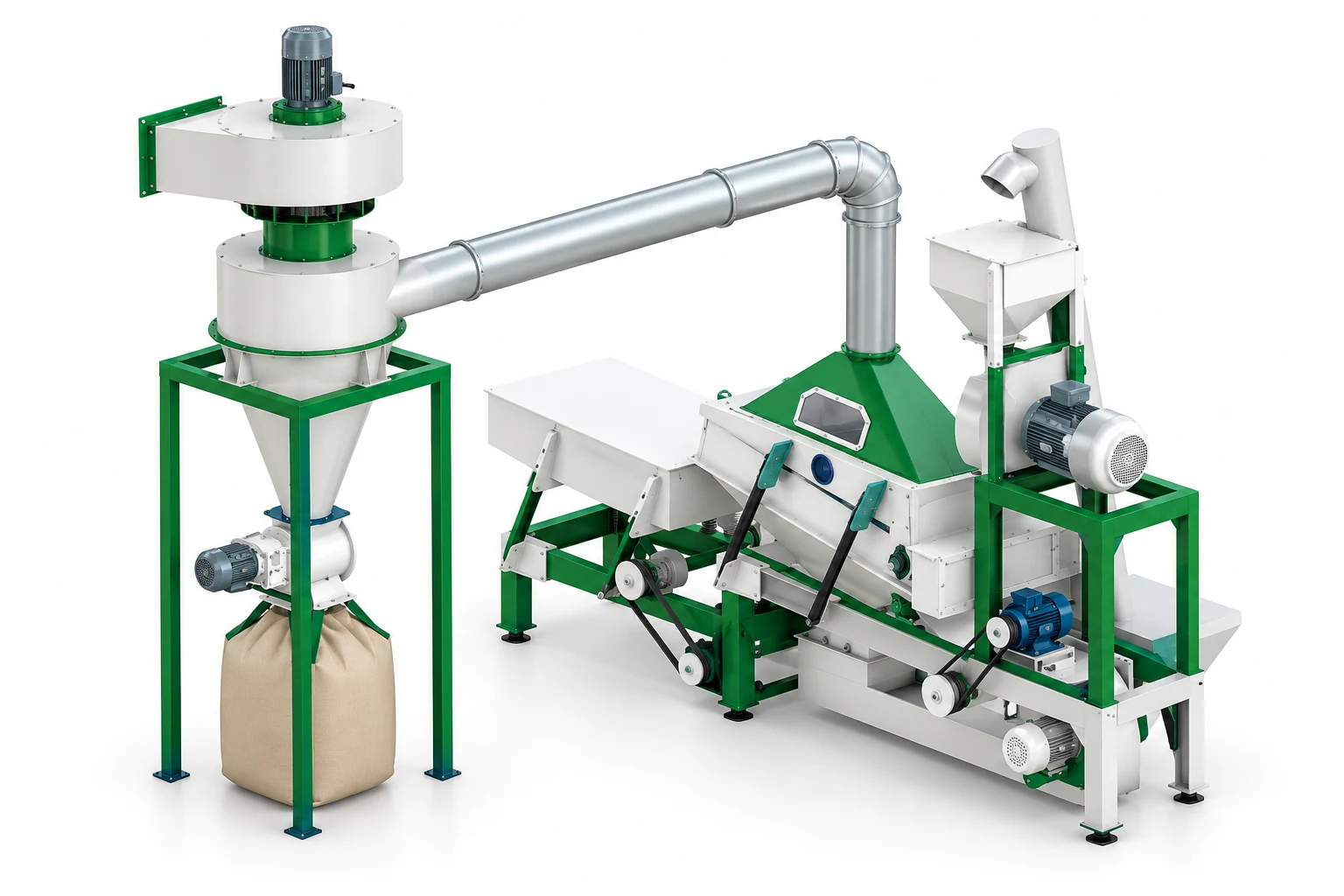
The Spelt Huller & Separator combines gentle glume de-husking, integrated chaff aspiration, and oscillating screen separation within a single compact monoblock frame for processing spelt, emmer, and einkorn wheat. By uniting the hulling chamber and the kernel-from-spikelet separator in one turnkey unit, it eliminates intermediate conveyors and automatically recycles unhulled spikelets until only clean, naked berries discharge.

Machines ↗

Overview

Cleaned spelt spikelets entering the upper hulling head of the Spelt Huller & Separator are gently rubbed between an elastomer-coated rotor and a perforated steel or wire-mesh stator mantle, loosening the tough clasping glumes without snapping the slender grain. The mixture then drops directly through an internal aspiration channel that extracts lightweight chaff before landing on an under-mounted oscillating separating deck that discharges naked spelt kernels and routes unhulled spikelets back to the inlet.

Technical Specifications

Technical ParameterSHS-05SHS-10SHS-15SHS-25
Processing Capacity3 – 6 t/h7 – 12 t/h13 – 18 t/h19 – 25 t/h
Hulling / De-Awning / Conditioning Uniformity98.0% – 99.0% homogeneous processing98.5% – 99.2% homogeneous processing99.0% – 99.5% homogeneous processing99.2% – 99.5% homogeneous processing
Total Motor Power2.2 kW4.0 kW7.5 kW11.0 kW
Rotor / Drum Working Diameter400 mm500 mm600 mm750 mm
Aspiration / Husk Extraction Airflow2,500 m³/h4,200 m³/h6,000 m³/h8,500 m³/h

The capacity and power ranges indicated in the table may vary depending on the crop type to be processed, initial foreign matter rate, moisture level, and machine configuration. Exact performance and actual measurement values are finalized following the engineering design and process detailing of the plant to be installed.

Selection and integration

Selecting a Spelt Huller & Separator is ideal for regional grain mills, organic farm-gate processors, and specialty ancient-wheat lines that require complete de-husking and cleaning within a modest building footprint. Trial runs on customer spelt spikelets establish the optimal rotor clearance, aspiration damper position, and sieve mesh aperture so naked grain recovery stays high with minimal broken berries.

Key points to specify

  • Confirm the crop, variety and incoming condition for Spelt Huller & Separator.
  • The fit of the “Spelt Huller & Separator” unit should be checked on a representative sample, with moisture, acceptable kernel damage, hull structure and crop variety matched to the planned line duty.
  • Use a product trial to define where the “Spelt Huller & Separator” unit fits; record moisture, acceptable kernel damage, hull structure and crop variety and the output expected by the following stage.
  • Place the “Spelt Huller & Separator” unit in the line drawing with its handoff elevations and cleaning access; set the acceptance basis with moisture, acceptable kernel damage, hull structure and crop variety.

GUIDE · TECHNICAL SELECTION

What is this machine used for?

A Spelt Huller & Separator performs both mechanical glume removal and downstream chaff and spikelet separation inside one integrated machine assembly. It delivers ready-to-mill or ready-to-sow naked spelt, einkorn, and emmer grains while automatically returning unhulled spikelets to the de-husking chamber.

01

The role in the process

Whereas high-capacity industrial plants often install standalone hullers followed by separate aspirators and paddy tables across multiple floors, the Spelt Huller & Separator condenses the entire de-husking loop onto a single floor level. Incoming spikelets only need preliminary scalping and destoning before entering the monoblock unit.

Having the aspiration fan and oscillating separating deck mounted directly beneath the hulling cylinder allows the operator to observe naked berry quality, chaff lift, and unhulled return rate from a single vantage point. Electrical and dust-exhaust connections are consolidated to simplify site installation. Cleanout doors simplify variety changeovers.

02

Material and application suitability

Hulled ancient wheats—including spelt, emmer, and einkorn—feature tough outer glumes that remain tightly locked around a brittle, elongated kernel after combine harvesting. The resilient friction elements inside the Spelt Huller & Separator strip away those husks gently while the lower sieve deck adjusts easily to the distinct kernel widths of each ancient grain species.

Spikelet moisture and glume toughness govern how tightly the hulling gap and rotor speed should be set: rather than forcing hundred-percent de-husking in a single violent pass that would crack dry kernels, the integrated separator allows a gentler hulling setting by cleanly isolating and returning the small unhulled fraction.

03

Selection checklist

Before ordering a Spelt Huller & Separator, confirm total installed motor power, chaff cyclone placement, included sieve aperture sizes, and unhulled return loop configuration. Acceptance checks should verify clean naked grain purity at the final spout alongside strict limits on broken kernels and germ damage.

Check motor power reserves, aspiration suction connections, and wear-liner replacement access around the grinding chamber. Specify hardened alloy impact plates, dynamic rotor balancing, and safety interlocks for continuous industrial duty. Sample test runs at target grain moisture establish the optimal feed rate and husk separation settings. All contact zones support fast inspection.

Integration into a processing line

Plant layout and interface planning

Because the Spelt Huller & Separator unites three processing steps in one frame, plant layout requires minimal headroom and eliminates long intermediate spouting runs. Sufficient aisle clearance should be provided at the front and side of the chassis to slide out the oscillating sieve frames and swing open the hulling mantle.

Recording the rotor speed, stator gap, aspiration air valve setting, and sieve deck inclination for spelt, einkorn, and emmer during commissioning lets operators switch between ancient wheat varieties in minutes. Regular inspection of the elastomer rotor lining ensures consistent friction grip throughout the harvest season.

Factors that affect operating performance

Balancing the internal recirculation rate is the key to gentle operation: allowing a modest percentage of tough spikelets to return from the separator deck back to the huller inlet keeps kernel breakage near zero and preserves high germination energy when producing seed spelt.

Process quality and line integration

Integrated dust and chaff extraction keeps the oscillating sieves free of bulky glume mats, ensuring sharp stratification between dense naked spelt berries and lighter unhulled spikelets across extended production shifts.

Frequently asked questions

What is the advantage of a combined Spelt Huller & Separator over standalone units?

By integrating the de-husking rotor, chaff aspiration channel, and oscillating separating screens into a single frame, the monoblock unit saves floor space and headroom while automatically recycling unhulled spikelets without extra conveyors.

Can the Spelt Huller & Separator process einkorn and emmer as well as spelt?

Yes, swapping the lower separating sieve sizes and adjusting the rotor speed and hulling gap allow the same machine to de-husk smaller einkorn and medium emmer spikelets gently alongside standard spelt varieties.

How does the integrated return loop reduce kernel breakage?

Instead of setting the huller aggressively to strip every stubborn spikelet in one pass—which would fracture dry kernels—operators use a gentle friction setting and let the built-in separator route any remaining unhulled spikelets back to the inlet.

REQUEST A TECHNICAL REVIEW

Spelt Huller & Separator

Looking for a compact, all-in-one Spelt Huller & Separator for your ancient grain mill or organic seed facility? Reach out to our team with your spelt, emmer, or einkorn varieties, moisture range, and target hourly capacity for a complete technical offer and layout drawing.