Overview
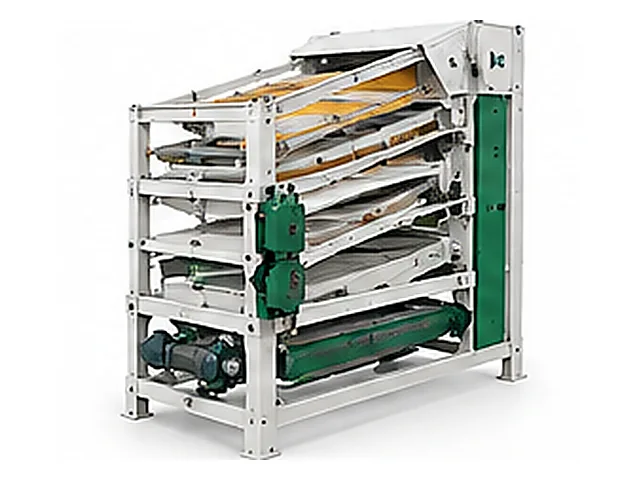
Incoming product flows across a vibratory feeder pan that breaks up loose clusters and spreads a thin, uniform layer onto stacked perforated or woven-wire screen decks. High-frequency linear vibration fluidizes the seed bed so sound kernels pass cleanly through the sizing apertures while coarse stalks ride over the top deck and fine dust or sand sifts through the bottom sheet, assisted by optional aspiration.
Technical specifications
The capacity and power ranges indicated in the table may vary depending on the crop type to be processed, initial foreign matter rate, moisture level, and machine configuration. Exact performance and actual measurement values are finalized following the engineering design and process detailing of the plant to be installed.
Key considerations
- Confirm the crop, variety and incoming condition for Vibratory Separator.
- The maintenance note for the “Vibratory Separator” unit should identify inspection and cleaning access at the installed position; record the product conditions summarized by the physical difference used, incoming mixture and required outlet fractions.
- The fit of the “Vibratory Separator” unit should be checked on a representative sample, with the physical difference used, incoming mixture and required outlet fractions matched to the planned line duty.
- The line drawing for the “Vibratory Separator” unit should identify product transfer, service space and interfaces with upstream and downstream equipment; record the product conditions summarized by the physical difference used, incoming mixture and required outlet fractions.
Typical applications
While versatile across small grains and pulses up to 25 t/h, the Vibratory Separator excels at lower, high-precision feed rates down to 2 t/h on low-density spice crops such as cumin seeds and coriander seeds. Elongated, ridged cumin seeds and spherical, ribbed coriander fruits require carefully matched oblong and round apertures paired with energetic vibratory agitation to prevent stem hair-pinning.