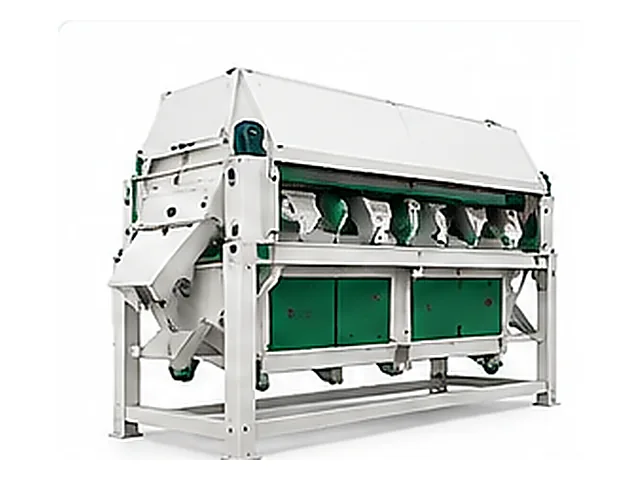
 Cleaning & Pre-Cleaning
Pre-Cleaner
Extracts orchard twigs, loose fibrous hulls, fine soil dust, and empty shriveled hulls at 5–40 t/h before in-shell almonds enter calibrated cracking rolls or bulk storage silos.
5–40 t/h↗

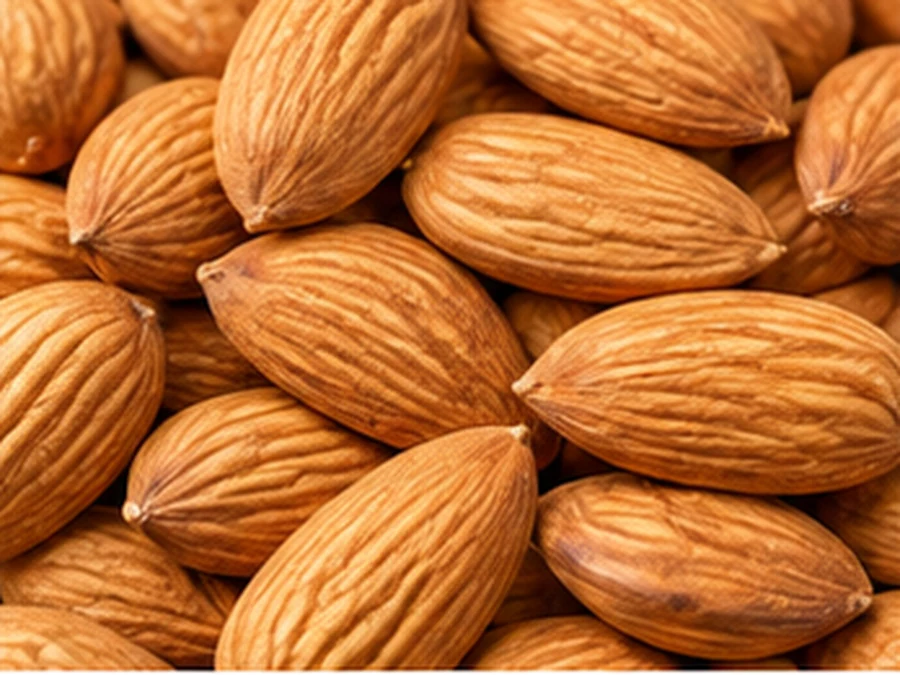
Industrial almond processing plants must bridge orchard huller-sheller operations and high-purity food-grade kernel conditioning across Nonpareil, Carmel, Butte, and hard-shell Mediterranean cultivars. Raw orchard runs arrive containing fibrous hull fragments, lignified endocarp shell shards, gummy or shriveled kernels, and navel orangeworm pinhole damage that require staged mechanical and aerodynamic separation. Configuring the line around calibrated shear-roll cracking, multi-stage pneumatic shell aspiration, thickness and width sizing for doubles removal, and optional hot-water blanching ensures maximum whole-kernel yield with minimal skin abrasion. Every stage from intake pre-cleaning to multispectral optical sorting is engineered from physical sample trials and target USDA or European confectionery specifications.
Establishing a continuous almond conditioning sequence requires balancing cracking gap tolerances, pneumatic shell lifting velocities, and gentle low-drop conveying to eliminate edge chipping and oil release on fragile kernels.
Selecting industrial almond processing equipment involves matching screen perforation geometry, fluidizing deck airflow, and optical camera wavelengths to your incoming shell-to-kernel ratio and target count-per-ounce grade.
Cleaning & Pre-CleaningExtracts orchard twigs, loose fibrous hulls, fine soil dust, and empty shriveled hulls at 5–40 t/h before in-shell almonds enter calibrated cracking rolls or bulk storage silos.
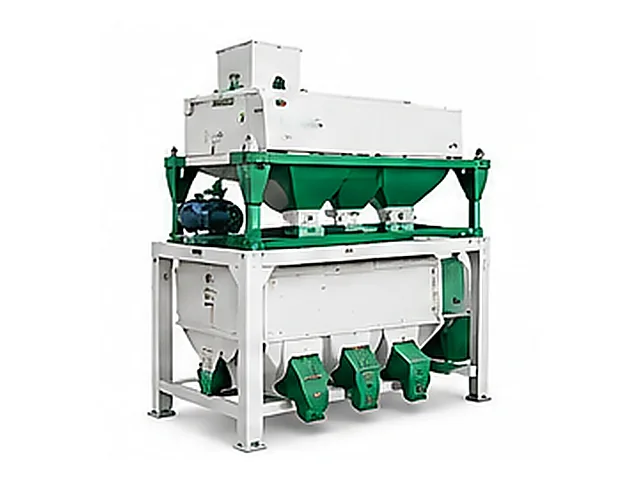 Separation
Separates dense stony endocarp shell fragments, gummy kernels, and insect-hollowed almonds from sound kernels at 1–20 t/h using precision fluidized-bed air stratification.
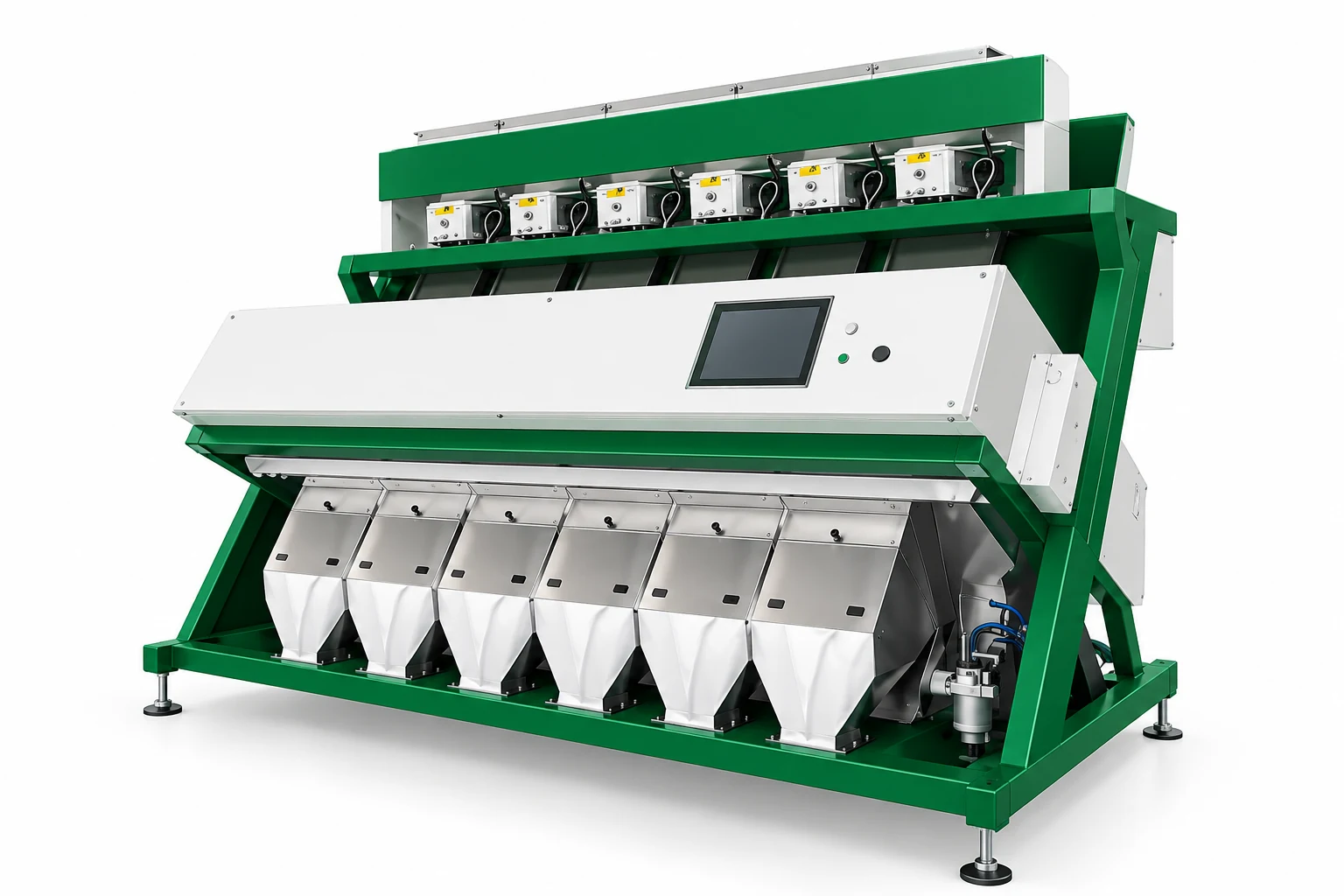 Optical Sorting
Combines RGB bichromatic cameras and InGaAs SWIR sensors at 1–20 t/h to eject shell shards of identical kernel density alongside concealed mold, gum spots, and chipped pellicles.
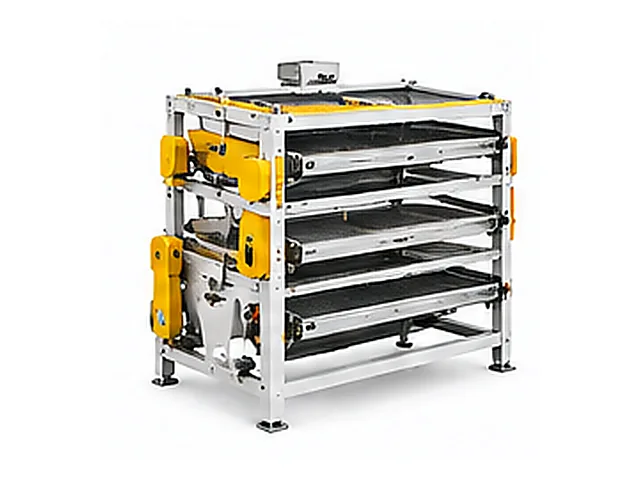 Grading & Sizing
Classifies shelled almond kernels by precise millimeter width and oblong slot thickness at 2–30 t/h to isolate twin kernels (doubles) and calibrate uniform count-per-ounce grades.
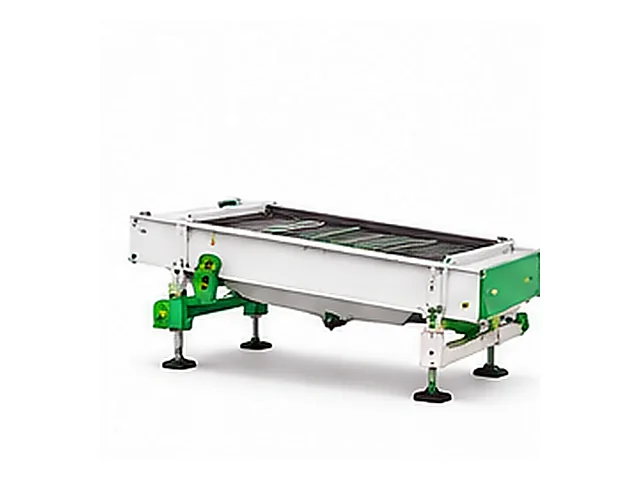 Conveying & Elevation
Transports natural and blanched almond kernels horizontally at 5–120 t/h on food-grade smooth belts without sliding friction, preserving brittle brown pellicle skins and preventing split cotyledons.
Engineering a commercial almond processing facility requires tailoring mechanical separation around shell hardness, kernel moisture content, and final market form—whether natural whole kernels, blanched silvers, or diced confectionery fractions. Soft-shell varieties such as Nonpareil demand delicate shear-roll clearances and multi-pass aspiration to prevent pellicle scuffing, whereas hard-shell cultivars require rigid calibration prior to cracking so smaller nuts do not pass uncracked while larger nuts shatter. By integrating oblong-slot thickness sizers, specific-gravity separators, and InGaAs infrared sorting, processors eliminate embedded shell fragments and insect-damaged kernels without sacrificing saleable meat recovery.
Once field debris and outer hulls are stripped, in-shell almonds are sized into narrow millimeter fractions so cracking rollers apply uniform compression without crushing the internal kernel. The cracked mixture passes through cascading aspirators and oscillating decks where free shells are lifted away and uncracked nuts return to secondary shear rolls. Dedicated oblong-hole thickness screens then isolate twin kernels (doubles) and broken chips from plump single kernels.
Equipment sizing in an almond plant must account for bulk density shifts between in-shell lots, natural meats, and wet-blanched kernels. Screen graders require interchangeable round-hole plates for count-per-ounce width grading and precision slotted decks for thickness sorting, while downstream hot-water scalding tanks, counter-rotating elastomer peeling rollers, and multi-zone belt dryers must be synchronized to loosen and strip the brown testa without inducing thermal oil migration.
Premium natural almond grades penalize torn skin (pellicle abrasion), chipped tips, and internal navel orangeworm feeding tunnels that harbor Aspergillus mold. Maintaining kernel moisture between 5.5% and 6.5% during conditioning reduces cotyledon brittleness, while cushioned transfer chutes, low-velocity belt conveyors, and bichromatic plus SWIR optical sorters ensure foreign shell tolerance stays below 0.05% and aflatoxin-contaminated nuts are reliably ejected.
Balancing aerodynamic aspiration and gravity table deck inclination is critical when separating almond shell pieces that share the exact thickness of whole kernels. If upward air velocity in the shell aspirator is set too aggressively, thin flat kernels are entrained into the biomass waste stream; conversely, under-aspiration overloads the gravity separator and optical sorter with woody endocarp shards that can breach retail zero-shell specifications.
Downstream market requirements dictate how almond handling and thermal stages are configured across the plant. Whole natural almonds bound for snack packs require zero-friction conveying to keep the brown skin intact, whereas marzipan, almond flour, and slivered-almond lines route calibrated kernels through 85–95 °C water scalders, rubber-roller skinners, and zone-controlled cooling tunnels that stabilize kernel moisture below 6% before slicing.
When evaluating turnkey almond processing proposals, plant engineers should benchmark suppliers using an identical orchard-run or shelled lot with documented percentages of doubles, gums, and shell fragments. Written performance guarantees must specify net whole-kernel recovery, mechanical breakage generated across cracking and conveying stages, compressed-air consumption on multi-chute optical sorters, and dust extraction volumes.
Acceptance testing in an almond plant must go beyond visual inspection of the final packing bin; commissioning engineers should weigh both the clean kernel stream and every reject fraction from aspirators, gravity decks, and optical sorters. Measuring the percentage of sound almond meats inadvertently discharged with shell waste or optical rejects allows precise tuning of air dampers, eccentric stroke speeds, and camera sensitivity thresholds.
Mechanical layout geometry directly governs whole-kernel retention in high-capacity almond facilities. Minimizing vertical drop heights, replacing high-speed centrifugal bucket elevators with gentle C-belt or pendulum bucket lifts, and lining all transition chutes with food-grade polyurethane elastomer sheets prevent tip chipping and preserve the smooth surface appearance demanded by export buyers.
Soft-shell cultivars like Nonpareil have thin, friable endocarps that split under light shear-roll pressure, requiring gentle aspiration to avoid tearing the delicate kernel skin. Hard-shell varieties such as Ferragnes, Tuono, or Padre require tight pre-calibration into 1–2 mm size bands before entering heavy-duty cracking rolls, followed by multi-deck gravity separation to isolate dense shell fragments that match kernel dimensions.
Twin almonds that develop inside a single shell exhibit an asymmetrical flat face and abnormal thickness profile compared to single kernels. After round-hole screens classify almonds by width into count-per-ounce brackets, precision oblong-slot thickness graders and dimensional optical cameras isolate thicker or flatter doubles so top-tier Supreme and Extra No. 1 grades meet strict uniformity limits.
A specific-gravity separator excels at removing lightweight shriveled almonds, insect-hollowed meats, and denser stones, but certain curved shell fragments and gumming defects share the exact specific weight of a healthy almond kernel. Combining RGB cameras with Short-Wave Infrared (InGaAs) sensors detects the distinct moisture and lignocellulose spectral signature of almond shells and internal fungal decay, ejecting them with compressed air.
Effective almond blanching depends on controlled immersion in 85–95 °C water or steam for 90 to 180 seconds to hydrate the pectin layer beneath the brown testa without cooking the white cotyledon. Immediately after scalding, kernels pass between counter-rotating soft elastomer rollers running at differential speeds with warm water sprays, followed by multi-pass belt drying and cooling to restore crisp texture and prevent pellicle yellowing.
Before bulk bin storage or vacuum carton packaging, processed almonds must be stabilized at 5.0% to 6.0% kernel moisture and water activity below 0.60 to inhibit Aspergillus flavus growth and free-fatty-acid rancidity. Cool, dark warehouse environments maintained at 4–10 °C and 55–65% relative humidity preserve kernel crunch, inhibit lipid peroxidation, and protect against post-process insect re-infestation.